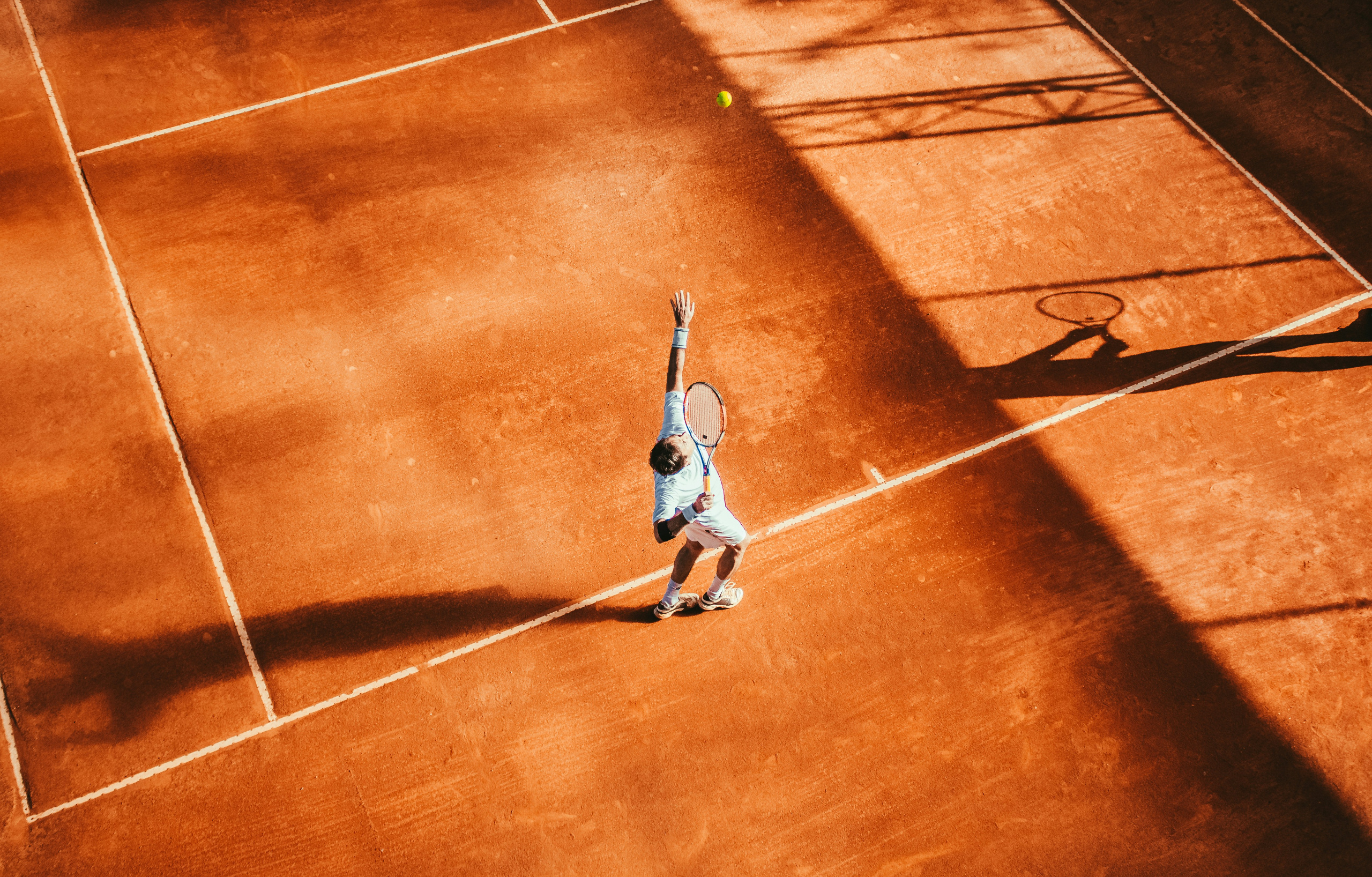
Court Movement
Split step, first-step acceleration, lateral movement, crossover movement, recovery and positioning.

AEON / Private + semi-private training
Train the body behind your tennis.
Private and small-group fitness coaching for adult tennis players who want to move better, stay competitive and keep playing.
Request a Tennis Fitness ConsultationAEON combines strength, movement, conditioning and tennis-specific biomechanics in one integrated training approach.
San Diego trainingA tennis point can require you to accelerate, brake, change direction, rotate, reach, stabilize, react and produce force within seconds. Then do it again. And again.
A player may perform hundreds of split steps, lateral movements, directional changes, rotational actions and accelerations during a match.
That makes tennis a very different physical test from jogging, cycling or conventional resistance training.
Cardiovascular fitness matters. Strength matters. But neither automatically produces good tennis movement. The body has to learn how to use those qualities on court.
AEON trains the physical movement system behind the sport.
Split step, first-step acceleration, lateral movement, crossover movement, recovery and positioning.
Getting to the ball is only part of the movement problem. The player must also absorb force, stop under control and recover into the next position.
Tennis repeatedly transfers force from the ground through the legs and trunk into the upper body. We train rotational strength and control as part of a complete kinetic chain rather than treating the arm as the source of the stroke.
Players repeatedly hit while moving, reaching or reorganizing position. Balance and coordination determine how effectively physical strength can be expressed under those conditions.
Split steps, serves, directional changes and rapid court movement require fast loading and unloading of the lower body. Progressive elastic work can help prepare muscles, tendons and connective tissue for those demands.
Tennis combines repeated high-intensity effort with periods of recovery. Training should prepare you not only to reach the ball early in the match, but to keep moving effectively later in it.
Many tennis players already train. They lift. They run. They cycle. They take fitness classes. Those activities can build substantial physical capacity.
The missing question is whether that capacity transfers to tennis.
Can you accelerate laterally? Can you stop effectively? Can you rotate while maintaining balance? Can you recover quickly after an open-stance forehand? Can you repeatedly organize your body when the next ball is unpredictable?
AEON connects conventional fitness to those demands.
Tennis is unusual because it combines several physical and cognitive demands within one activity: aerobic and anaerobic conditioning, coordination, balance, reaction, movement in multiple directions, elastic force production, skill, decision-making and social participation.
Observational research has repeatedly associated racquet-sport participation with favorable health and longevity outcomes, although those findings do not prove that tennis itself causes longer life.
AEON takes a practical view. If tennis is something you want to continue doing for decades, your training should help preserve the physical capacities the sport requires.
Adult recreational players often focus on the shoulder, elbow and stroke mechanics. The lower body deserves equal attention.
Tennis repeatedly loads the feet and ankles, calves and soleus, Achilles tendons, knees, hips and trunk. Those tissues manage acceleration, braking, lateral movement, rotation and repeated elastic force.
AEON programming may include progressive calf and soleus strengthening, foot and ankle capacity, multidirectional strength, controlled deceleration and appropriately progressed elastic loading.
The objective is not to promise injury prevention. No training program can eliminate injury risk. The objective is to better prepare the body for the loads tennis repeatedly creates.
AEON Tennis Fitness is designed primarily for adults who want to remain physically capable on court. It may be a strong fit for:
J. Semrau is a former fitness coach at Mouratoglou Tennis Academy. That experience informs AEON’s approach to the strength, movement and conditioning demands of adult tennis.
AEON uses a limited-client model, with individualized coaching and small groups of compatible players. Location and availability are confirmed individually.
AEON fitness coaching is complementary to technical tennis instruction. We are not trying to replace the client’s tennis coach. We prepare the body to better execute the game.
Individual assessment and programming based on movement, playing level, training history and goals.
Small groups of compatible players working on tennis-specific strength, movement and conditioning.
Where appropriate, training can connect fitness work with the movement demands experienced on court.
Padel players can also discuss private physical preparation with AEON. The training brief considers strength, lateral movement, controlled stopping, rotation and repeated efforts, alongside playing frequency and recovery.
Programming is adapted to the player and the demands of padel. This is fitness coaching, complementary to technical padel instruction. Tell us your location, playing schedule and goals so we can discuss the appropriate format.
A stronger tennis player is not simply someone with larger muscles or better cardiovascular fitness.
Performance emerges from interacting systems: strength, mobility, tendons, fascia and connective tissue, balance, proprioception, coordination, conditioning, recovery, movement skill and training history.
AEON looks at the whole system. Then we use the minimum amount of complexity necessary to train it.
We observe movement, training history, sport demands and tolerance to exercise. We train strength, mobility, conditioning and movement skill within the scope of fitness coaching.
Persistent symptoms, significant functional limitations or a possible medical issue warrant evaluation by an appropriately qualified clinician. AEON does not diagnose or treat medical conditions.
Before you begin
AEON Tennis Fitness focuses on physical preparation rather than stroke instruction. It is complementary to technical tennis coaching.
Training may include strength, movement, acceleration, deceleration, rotation, balance, coordination, conditioning and progressive elastic loading.
No. It is designed for adult recreational and competitive players who want their physical training to support their tennis.
Yes, where compatible players can be grouped appropriately. Format, location and availability are confirmed individually.
No training program can guarantee injury prevention. The goal is to improve physical capacity and better prepare the body for tennis-specific loads.
Start with a conversation
You do not need to train like a professional tennis player. You need to prepare intelligently for the tennis you want to play.
Move earlier. Brake better. Rotate with control. Stay balanced. Build strength. Maintain conditioning.
Keep the body capable of solving the movement problems the game keeps giving you.
Train the body behind your tennis.
Request a Tennis Fitness Consultation