In this article
For active adults, the Achilles tendon is easy to ignore until it becomes the limiting factor. It does not attract the same attention as the knee, hip, back, or shoulder, yet it sits at the center of nearly every activity that asks the body to walk faster, run, jump, push off, change direction, or absorb force.
That matters because the Achilles is not simply a cord connecting the calf to the heel. It is part of a larger lower-leg system that includes the gastrocnemius and soleus, the foot and ankle, the nervous system, connective tissue, balance, training history, recovery, and the specific demands of the sport being played.
The central training question is therefore not whether the Achilles is “tight.” It is whether the system has enough capacity for the load being placed on it.
Recent epidemiology makes that question relevant. A 2026 Sports Medicine systematic review and meta-analysis covering more than 630 million people estimated a pooled Achilles rupture incidence of 15.7 per 100,000 person-years, with incidence rising over time. About 68 percent of ruptures in the included studies were sport related, and the greatest burden was observed among physically active middle-aged men.
That does not mean sport is dangerous.
It means the transition from general fitness to high-force sport deserves better preparation.
Tennis, pickleball, basketball, running, soccer, and similar activities are particularly demanding because the Achilles acts as both a force transmitter and an elastic structure.
During running and faster sporting movements, tendon loading can reach many multiples of body weight. A person can be strong enough to squat, cycle for an hour, or complete conventional gym workouts and still be underprepared for repeated push-off, braking, jumping, and elastic loading.
This is where conventional fitness can leave a gap.
Strength training is important, but not every program develops plantar-flexor strength through useful ranges, single-leg control, repeated calf endurance, elastic capacity, or the ability to absorb force quickly.
Cardiovascular training can improve work capacity without preparing the Achilles for rapid loading.
Stretching can improve range of motion when range is limited, but flexibility alone does not create tendon capacity.
Current clinical guidance reflects that distinction.
The 2024 clinical practice guideline for midportion Achilles tendinopathy published in the Journal of Orthopaedic & Sports Physical Therapy recommends tendon-loading exercise as first-line treatment rather than relying on rest or passive care alone.
Importantly, the evidence does not support one mandatory exercise style for every person. Eccentric, progressive resistance, heavy-slow, and isometric approaches may all have a place depending on the individual, condition, and stage of loading.
For healthy adults, exercise research points in the same general direction.
A 2026 systematic review and network meta-analysis found that Achilles morphology and mechanical properties can adapt to training. Different loading strategies produced different effects, with longer-term resistance and isometric loading showing favorable effects on tendon mechanical properties and plyometric training influencing other aspects of tendon adaptation.
The authors also emphasized substantial heterogeneity across the research.
That matters because the useful conclusion is not that everyone needs one specific Achilles protocol.
The useful conclusion is simpler:
The tendon responds to progressive mechanical demand.
For active adults, that demand can be built in layers.
At the foundation is calf strength, including both straight-knee and bent-knee work so the gastrocnemius and soleus are challenged.
Above that sits single-leg control, foot and ankle capacity, balance, and the ability to produce force through useful ranges.
Once those foundations are adequate, faster loading becomes relevant: skipping, hopping, rebounding, short accelerations, controlled decelerations, and eventually sport-specific change of direction.
The progression matters because Achilles loading differs dramatically across exercises.
Experimental research has demonstrated more than a twelvefold difference in tendon loading between relatively low-load exercises such as seated heel raises and higher-load activities such as single-leg hopping.
That gives training a useful continuum rather than a binary choice between “rest” and “play.”
It also illustrates an important AEON principle:
A calf raise is not a split step.
Strength provides capacity.
Sport requires the body to express that capacity quickly, repeatedly, and under changing conditions.
The AEON Systems Lens also prevents us from reducing every Achilles problem to biomechanics.
Research comparing runners with Achilles tendinopathy to asymptomatic runners has identified differences in strength, muscle activity, and movement characteristics in some studies, but the findings are inconsistent.
Static foot posture and ordinary asymmetry should not automatically be treated as pathology.
A person does not need a perfectly symmetrical gait, perfectly aligned ankle, or theoretically ideal posture before training.
The more useful questions are functional:
Can the person produce force?
Can the lower leg tolerate repeated loading?
Can the person control a single-leg position?
Can they accelerate and decelerate?
How does the tendon respond during and after training?
Is capacity improving over time?
Other systems may also become relevant when the history suggests them.
Metabolic health, previous tendon problems, recovery, sudden changes in sport exposure, training frequency, sleep, age, medications, and the difference between current capacity and requested load can all influence the picture.
Certain medications deserve particular attention.
Fluoroquinolone antibiotics have a documented association with Achilles tendon injury, with risk appearing greater in older adults and when corticosteroids are also involved.
That is not something a fitness professional should diagnose or manage medically.
It is a reason to recognize when training should stop being the only conversation.
This is where AEON’s practical SCREEN / TRAIN / REFER model becomes useful.
SCREEN
Look at the pattern.
What changed?
Is the issue pain, stiffness, weakness, reduced push-off, recurring cramping, loss of confidence, or simply fatigue?
Did training volume increase?
Did someone begin playing tennis or pickleball more frequently?
Did running mileage change?
Was there a change in surface, footwear, recovery, work demands, or overall activity?
Is there a sudden “pop,” marked swelling, substantial loss of function, or another red flag?
The objective is not to diagnose every symptom.
It is to understand enough context to decide what belongs in training and what does not.
TRAIN
Train the capacities that fitness can legitimately change.
That can include:
- calf strength
- soleus strength
- useful ankle range of motion
- foot and ankle capacity
- single-leg control
- balance
- proprioception
- progressive tendon loading
- multidirectional strength
- elastic capacity
- acceleration
- deceleration
- conditioning appropriate to the sport
For some clients, basic resistance training may be enough initially.
For others, the program eventually needs to include faster and more reactive loading because their sport demands it.
REFER
Refer when the presentation exceeds fitness scope.
Persistent or worsening pain, significant functional loss, suspected rupture, sudden inability to push off normally, neurological symptoms, unexplained bilateral symptoms, or relevant medical or medication factors warrant evaluation by an appropriately qualified professional.
That may include a sports medicine physician, physical therapist, or another licensed clinician depending on the situation.
The objective is not to build a large medical team around every active adult.
It is to know when the problem is no longer primarily a training problem.
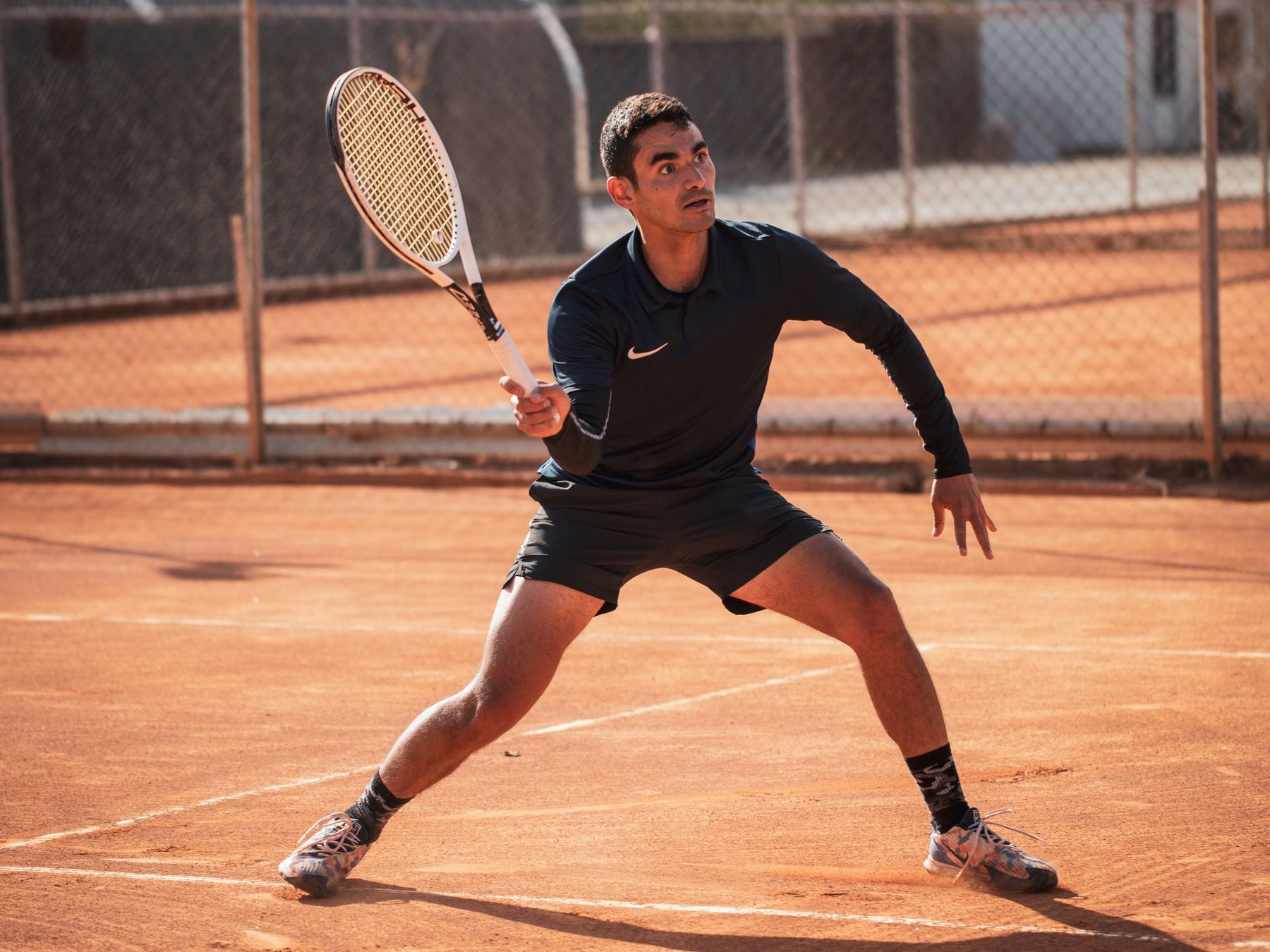
For tennis players, this distinction becomes particularly important.
Tennis repeatedly asks the lower leg to solve different problems under time pressure.
A split step is not a calf raise.
A wide forehand recovery is not a treadmill jog.
A sprint toward a drop shot followed immediately by a hard stop is not steady-state cardio.
Tennis combines acceleration, deceleration, balance, rotation, reaction, elastic loading, coordination, and repeated directional change.
Pickleball creates similar lower-leg demands, even if the court is smaller and average cardiovascular intensity may be lower.
Running creates another demand profile again: highly repetitive loading, often over substantially longer periods.
The Achilles has to tolerate whatever activity the person repeatedly asks it to perform.
This is also where fascia and the wider connective-tissue system fit into the discussion.
The Achilles does not work in isolation.
Muscle, tendon, fascia, joint structures, and the nervous system participate in transmitting and controlling force across the lower limb.
Fascia should not be treated as a magical explanation for injury, stiffness, or movement dysfunction.
But connective tissue is a legitimate part of the body’s force-transmission and adaptation system.
Progressive strength, multidirectional movement, appropriate elastic loading, mobility where needed, and recovery all contribute to the larger capacity picture.
The goal is not to make the Achilles the center of every training program.
It is to stop treating it as an afterthought.
Long-term physical capability depends on having enough strength, tissue capacity, coordination, conditioning, and movement skill for the activities you actually want to do.
If those activities include tennis, pickleball, running, soccer, basketball, field sports, or any activity involving repeated acceleration, jumping, and directional change, the lower leg deserves deliberate preparation.
That is a more useful definition of prevention than trying to predict exactly who will get injured.
Build capacity.
Progress load.
Pay attention to how the system responds.
And refer when the problem is no longer a training problem.
Selected research
- Incidence, Temporal Trends, and Surgical Shift of Achilles Tendon Rupture: A Systematic Review and Meta-analysis.Kotsifaki R, Malliaras P, Byron C, Marques J, Korakakis V. Sports Medicine. 2026;56:1467–1487.
- Achilles Pain, Stiffness, and Muscle Power Deficits: Midportion Achilles Tendinopathy Revision – 2024.Chimenti RL, Neville C, Houck J, Cuddeford T, Carreira D, Martin RL. Journal of Orthopaedic & Sports Physical Therapy. 2024;54(12):CPG1–CPG32.
- The effect of exercise training modalities on the morphological and mechanical properties of the Achilles tendon: a systematic review and network meta-analysis.Fu B, Qian Y, Wang Y, Fang J, Gu Y, Zhang X. Frontiers in Sports and Active Living. 2026;8:1782503.
- Exercise Progression to Incrementally Load the Achilles Tendon.Baxter JR, Corrigan P, Hullfish TJ, O’Rourke P, Silbernagel KG. Medicine & Science in Sports & Exercise. 2021;53(1):124–130.